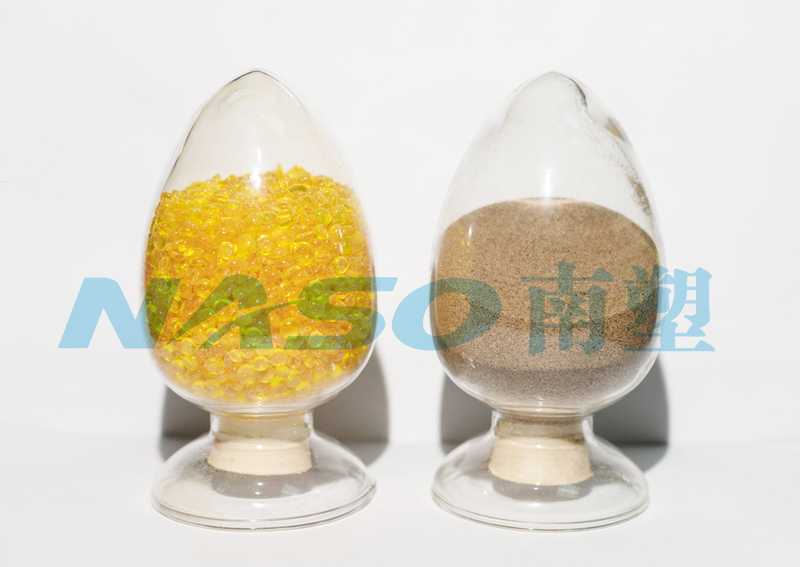
Casting with phenolic resin coated sand
Casting with phenolic resin coated sand
Casting with phenolic resin coated sand
- Product Details

[Product performance]
This series of products are made by polycondensation and drying of phenol and formaldehyde. It has the advantages of good fluidity, high bending strength, low free phenol content, fast polymerization speed, and good shelling resistance.
[Applications]
Including cast iron, ductile iron, ordinary cast steel, non-ferrous metal castings, casting coatings, and special coated sand for casting sand.
[Main technical indicators]
model | Exterior | Softening Point (℃) | Gel time (S/150℃) | Flow long (Mm/125℃) | Free phenol (%) | Product Usage |
NS-1218 | light yellow Bar/Granular | 86~92 | 15~35 | 25~50 | 3.5~5.0 | Fast gathering speed/mold or core |
NS-1210 | 76~82 | 75~95 | 75~100 | ≤1.0 | Slow polymerization speed/mold or core | |
NS-1238 | 82~90 | 70~90 | 70~90 | ≤1.0 | Slow polymerization speed/mold or core | |
NS-1248 | 80~86 | 55~65 | 70~95 | ≤1.0 | Medium speed/mold or core | |
NS-1258 | 88~96 | 35~55 | 40~70 | ≤1.0 | Medium speed/mold or core | |
NS-1268 | 82~90 | 25~45 | 40~70 | ≤1.0 | Fast gathering speed/mold or core | |
NS-1278 | 82~90 | 45~55 | 40~70 | ≤1.0 | Medium speed/mold or core |
[Use and precautions]
Thermoplastic phenolic resin is usually used to produce coated sand, and a curing agent-hexamethylenetetramine is added during the production process. The resin can be melted during the coating process, and then coated on the sand surface. During the curing process, the high temperature will melt the phenolic resin again to achieve cross-linking and curing of the resin.
Coated sand mainly includes 95-99% sand and 1-5% resin (the amount of resin added is generally determined by environmental conditions, raw sand conditions, and sand mold strength requirements). The curing agent is 8-20% of the weight of the resin. When mixing the sand, first mix the raw sand with the curing agent, and then add the resin and mix for 1 to 2 minutes.
[packaging and storage]
The products are packed in kraft paper bags or woven silk bags lined with plastic bags, and the net weight is 25kg or 40kg. The product's model, batch number, weight and other information are marked on the package. The product should not be exposed to moisture or heat. It should be stored in a dry and ventilated warehouse. The storage temperature should be lower than 25℃, away from fire or heat sources, and avoid direct sunlight. It is also not advisable to stack the product too high. The storage period is 6 months from the date of manufacture.